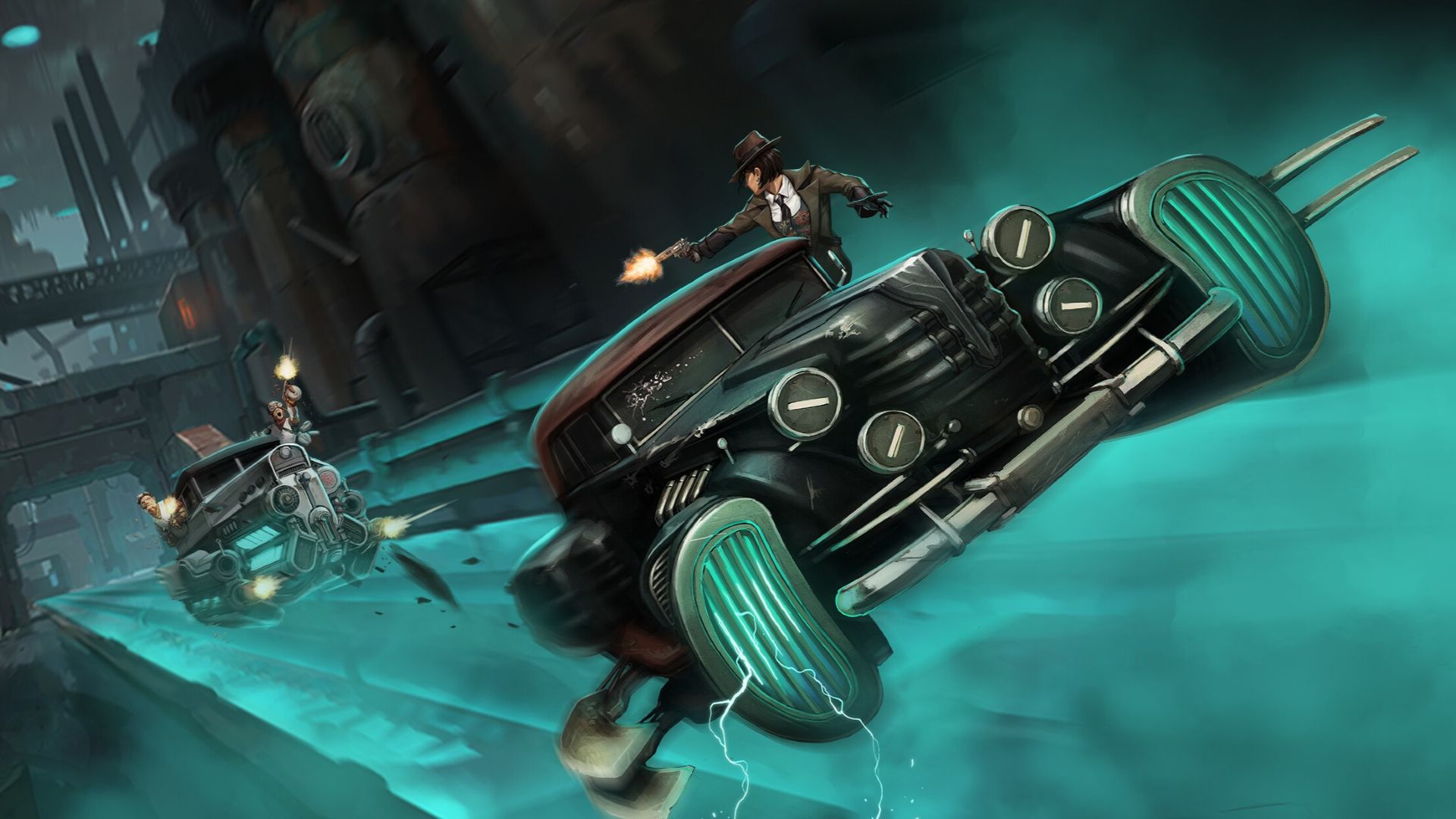
Aether & Iron Review: Is This Decopunk Noir RPG Worth Your Time in 2026?
When I first stumbled upon Aether & Iron, I’ll admit—I was skeptical. Another indie RPG promising Disco Elysium vibes? We’ve seen that claim before. But after thirty hours navigating the floating boroughs of an alternate 1930s New York, dodging corrupt barons and engaging in tactical car combat that genuinely surprised me, I realized this decopunk gem might be one of 2026’s most underrated releases.
If you’re tired of cookie-cutter RPGs and you’ve been craving something with real personality—something that takes risks with its setting and combat—keep reading. Because Aether & Iron delivers an experience you genuinely haven’t played before.
What Exactly Is Aether & Iron?
Aether & Iron is a fully-voiced narrative RPG developed by Seismic Squirrel and Chaos Theory Games, released on March 30-31, 2026 for PC (Steam), with macOS support. Set in an alternate 1930s where anti-gravitational “aether” technology has literally lifted New York City into the sky, you play as Giovanna “Gia” Randazzo—a down-on-her-luck smuggler trying to survive in a world of political corruption, revolutionary movements, and high-speed car chases on gravity-defying highways.
Think Disco Elysium meets BioShock, with a healthy dose of film noir thrown into the mix. The game blends point-and-click exploration with dice-roll skill checks and—here’s where it gets interesting—turn-based vehicular combat that plays out like a tactical puzzle on wheels.
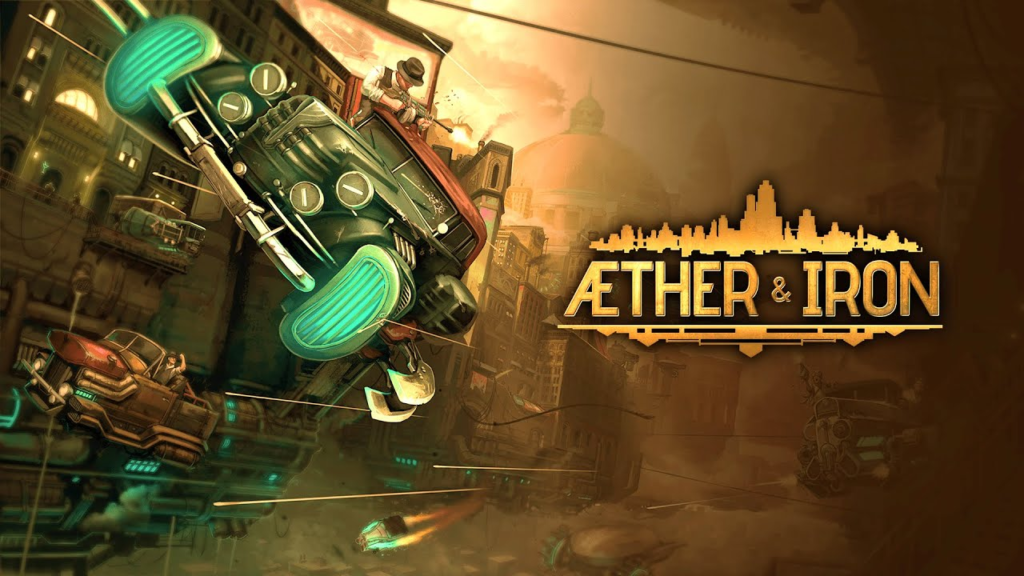
Key Features at a Glance
- Release Date: March 30-31, 2026 (PC/Steam, macOS)
- Developer: Seismic Squirrel, Chaos Theory Games
- Price: $24.99 USD (Steam)
- Metacritic Score: 81/100 (based on critic reviews)
- Playtime: Approximately 25-35 hours for main story
- Voice Acting: Fully voiced in English with subtitles in 9 languages
The Story That Hooked Me: Floating Cities and Fallen Reputations
Aether & Iron doesn’t waste your time. The game opens with Gia at rock bottom—her reputation as a reliable smuggler destroyed after a job went catastrophically wrong. When a mysterious fixer offers her what seems like easy money (escort a young woman from the wealthy Uppers district to the impoverished Lowers), you know things won’t go smoothly.
That young woman is Eleanor “Nellie” Reinhardt, a brilliant scientist carrying research papers that could change everything about New York’s floating existence. She’s being hunted by shadowy forces, and before you know it, you’re caught in a web of conspiracy involving tyrannical barons, revolutionary groups, and the unstable aether technology keeping the entire city from plummeting into the abyss below.
What makes this narrative sing isn’t just the plot twists—though there are plenty. It’s the voice acting and writing quality that elevates every conversation. Australian voice actress Rhiannon Moushall (who you might recognize from The Drifter) brings Gia to life with a weary cynicism that feels earned, not performative. Every line drips with the kind of hard-boiled prose you’d find in a Raymond Chandler novel, yet somehow it never feels overwrought.
Official Gameplay Trailer – See the decopunk world in action
How Aether & Iron Actually Plays: Three Pillars of Gameplay
1. Point-and-Click Exploration with Gorgeous Hand-Drawn Environments
Forget 3D open worlds. Aether & Iron uses beautifully illustrated, hand-drawn backdrops inspired by 1930s Detective Comics and Art Deco architecture. You click to move between locations on a map of floating New York, from the gilded towers of Astoria Bay to the grimy streets of the Lowers.
The art style might not be for everyone—it’s static rather than fully animated—but there’s an undeniable charm to the approach. It feels like exploring a living graphic novel, and for a small indie team, the visual identity is remarkably cohesive.
2. Dice-Roll Skill Checks: Brass, Smarts, and Hustle
Character dialogue in Aether & Iron uses a dice-roll system with three core stats:
- Brass: Your ability to intimidate, force, and physically overpower situations
- Smarts: Intelligence, perception, and analytical thinking
- Hustle: Charisma, persuasion, and street smarts
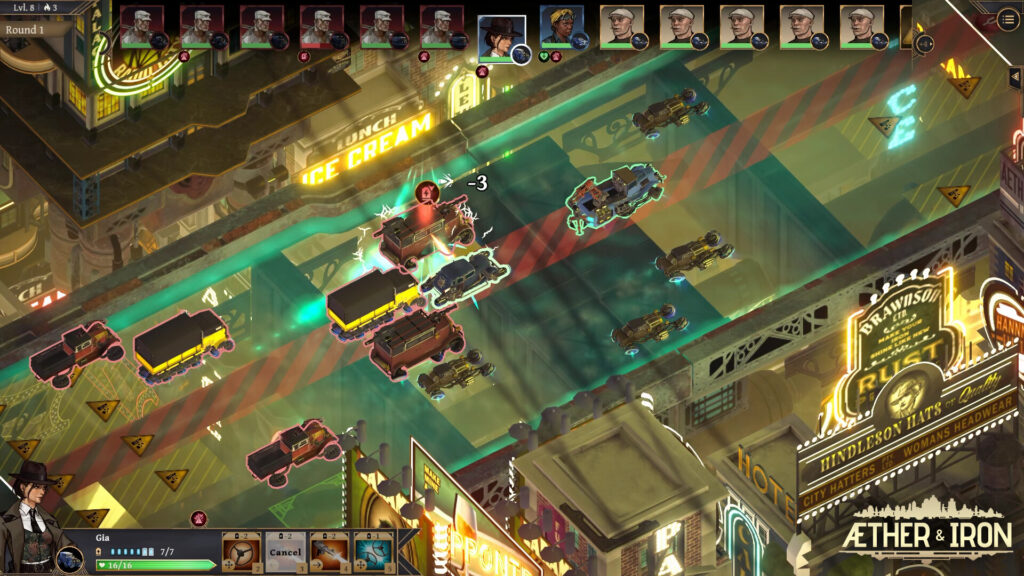
You roll two six-sided dice and add bonuses from your stats, your party members’ morale, and environmental factors. Rolling double ones means a critical failure; double sixes? Critical success. Unlike some RPGs where failing skill checks feels punishing, Aether & Iron often makes failures just as narratively interesting as successes.
I found myself specializing in Smarts and Hustle, which meant I could talk my way out of most situations, but when Brass checks came up, I had to rely on luck or my companions. That specialization created genuinely tense moments where I couldn’t just reload and brute-force my way through.
3. Turn-Based Car Combat: The Game’s Secret Weapon
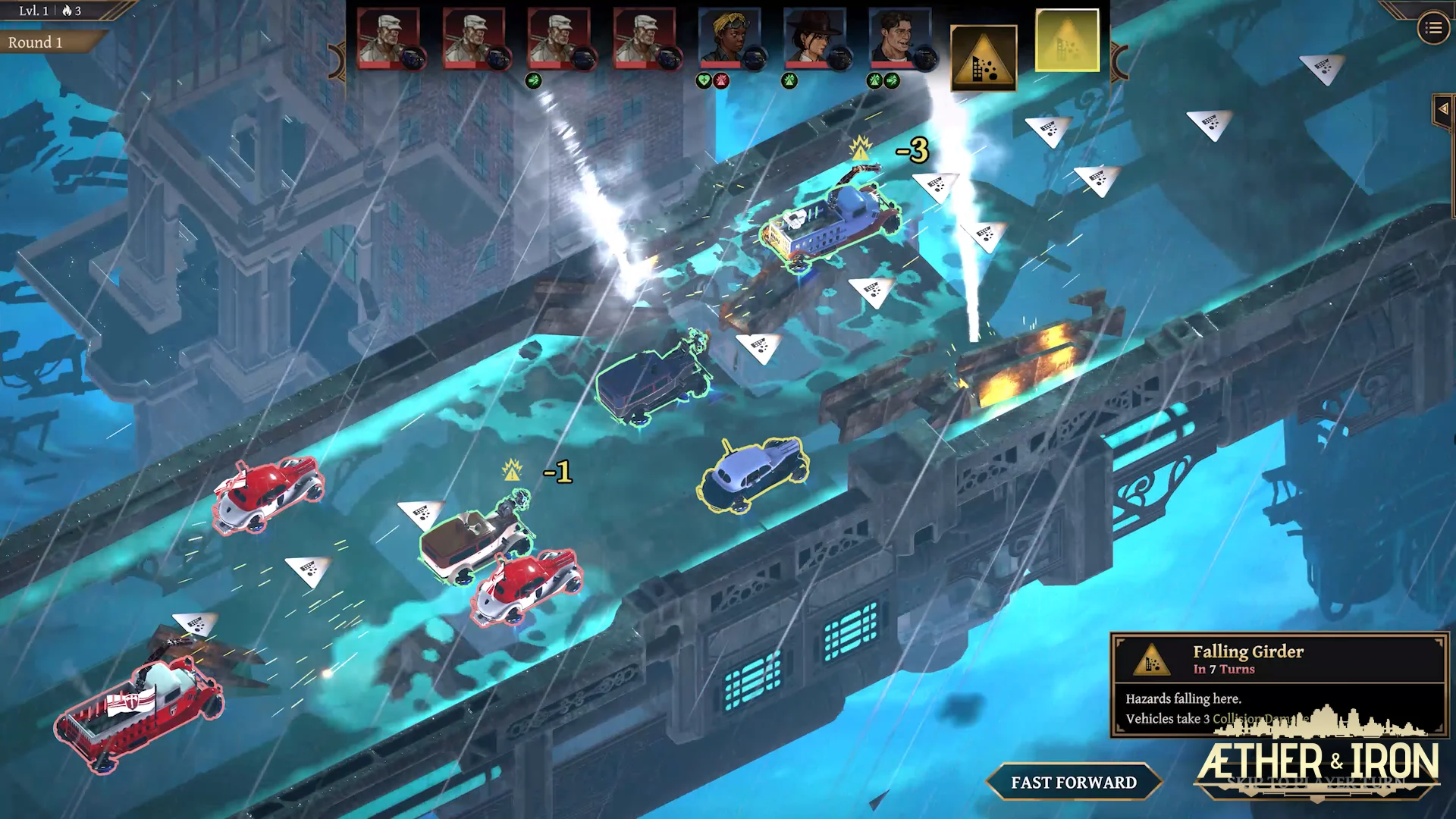
Here’s where Aether & Iron truly differentiates itself. Combat takes place on the aether-powered highways of New York, with you and your crew piloting customizable vehicles in tactical, grid-based battles.
Think of it like chess meets Rush Hour (that sliding puzzle game). Each car has:
- Weapons (forward-facing guns, side-mounted flamethrowers, grenade launchers)
- Armor plating (light cars trade defense for speed)
- Special abilities (smoke screens, ramming attacks, hidden compartments)
- Weight limits (affecting speed and maneuverability)
Moving forward costs significantly more action points than falling back, creating interesting tactical decisions. Do you gun it forward to flank an enemy, knowing you’ll be vulnerable next turn? Or do you play defensively, letting your tow truck companion soak damage while you pepper enemies from range?
Environmental hazards add another layer—falling debris, traffic jams, red zones that instantly destroy any vehicle caught in them at round’s end. Combat isn’t just about damage numbers; it’s about positioning, timing, and reading the battlefield.
Full Review: Disco Elysium Style RPG With Car Combat
Your Crew: Companions Worth Fighting For
No noir story is complete without a diverse cast of morally ambiguous allies, and Aether & Iron delivers. You can recruit companions who each bring unique combat abilities, faction perspectives, and personal storylines.
Standout companions include:
- Nílan: Your childhood friend from your native island, fiercely loyal but awkward navigating mainland politics (romanceable)
- Fausta: A sophisticated Thélème spy who shifts personas like changing coats
- Sybille: A cutthroat political operative from noble lineage who becomes surprisingly loyal (romanceable)
- Ludwig: A cynical ex-mercenary with deep hatred for the ruling classes (romanceable)
Companion approval matters. High approval unlocks powerful combat synergies, personal quests, and potential romances (four companions are romanceable). Low approval? They might betray you or leave entirely.
The writing for these characters is where Aether & Iron shines brightest. The banter between Gia and the chipper-yet-naïve Nellie provides genuine emotional grounding, while Ludwig’s cynical worldview creates fascinating friction with more idealistic party members.
The Decopunk Setting: New York Reimagined
The alternate history of Aether & Iron is meticulously crafted. After a mysterious substance called “aether” was discovered, humanity developed anti-gravity technology. New York City was lifted into the sky in segments, creating a class-stratified society where:
- The Uppers live in gleaming towers, insulated from the chaos below
- The Lowers struggle in poverty-stricken districts barely held aloft
- The Well—a massive storm of aether energy—churns ominously beneath everything
The worldbuilding draws clear parallels to our real-world class struggles and climate crisis. The barons (corrupt leaders of New York’s districts) hoard resources and power while the working-class “aethoneers” who maintain the infrastructure are treated as disposable.
This isn’t subtle political commentary, but it works because the setting feels lived-in rather than preachy. Characters debate politics naturally through their own self-interest, not as mouthpieces for the developers.
Highly Immersive Alternative 1930s New York City RPG with Intense Vehicle Combat
Pricing, System Requirements, and What You’re Actually Getting
How Much Does Aether & Iron Cost?
Steam Price: $24.99 USD / £19.99 GBP / €24.99 EUR
For the amount of content (25-35 hours), that’s solid value. The game also features a free 2+ hour demo on Steam, which I strongly recommend trying before purchasing.
Can Your PC Run It?
Minimum Requirements:
- OS: Windows 10 or newer (64-bit)
- Processor: AMD FX 8300 / Intel Core i3 8300
- Memory: 4 GB RAM
- Graphics: GeForce GTX 950 / Radeon RX 460
- Storage: 15 GB available space
Recommended Requirements:
- OS: Windows 10 or newer (64-bit)
- Processor: Ryzen 5 1600X / Intel Core i5 8600K
- Memory: 16 GB RAM
- Graphics: Radeon R9 280 / GeForce GTX 1650
- Storage: 15 GB available space (SSD recommended)
macOS Support: Requires Apple Silicon M1 or better, macOS 15.0+
The game is relatively lightweight by modern standards. If you can run Disco Elysium or similar isometric RPGs, you’ll be fine.
Critical Reception: What Reviewers Are Saying
Aether & Iron currently holds a Metacritic score of 81/100 based on early reviews, with critics praising its ambition while noting some rough edges.
The Praise
GameBlast (95/100) called it “an RPG of masterful writing and stark contrasts” with “characters that make this New York a city with breathing lungs and a beating heart.”
Gameliner (90/100) highlighted the “compelling story wrapped in gorgeous visuals and smart, tactical combat” despite some bugs and heavy dialogue.
Checkpoint Gaming (85/100) praised how the game “takes immense joy messing around in the noir decopunk playground it has constructed, and that joy is often infectious.”
The Criticisms
Cubed3 (60/100) noted that while the story and combat system are clever, the game is “full of disruptive glitches and bugs that rear their heads far too frequently.”
Common criticisms across reviews include:
- Technical issues: Slow load times, occasional black screens, dialogue loops
- Pacing problems: Some narrative moments feel rushed
- UI quirks: Mouse and keyboard targeting can be finicky with overlapping menus
- Underused mechanics: The contraband smuggling system is interesting but rarely matters after the first few hours
Comprehensive buying guide covering features, combat, and story
What Aether & Iron Does Better Than Its Inspirations
1. Car Combat Actually Works
Let’s be honest—vehicular combat in RPGs is usually terrible. Aether & Iron makes it work by treating cars as characters with distinct roles (tanks, DPS, support) and making positioning just as important as raw stats.
2. Failure Feels Meaningful, Not Punishing
Failed dice rolls don’t lock you out of content. They open different, equally interesting narrative paths. I genuinely looked forward to seeing what ridiculous thing Gia would say after botching a Brass check.
3. The Setting Feels Fresh
We’ve had steampunk, cyberpunk, dieselpunk—but decopunk? The Art Deco aesthetic combined with anti-gravity technology creates a visual identity that stands apart from the usual fantasy or sci-fi tropes.
What Holds It Back From Greatness
Technical Polish Issues
The developers are actively patching bugs, but at launch, expect:
- Long load times between areas
- Occasional save system hiccups
- Minor dialogue repetition or mispronunciation
These are annoying but rarely game-breaking. Still, if you’re the type who can’t tolerate any jank, you might want to wait for a few more patches.
Some Systems Feel Half-Baked
The Heat system (representing how much attention you’re attracting from authorities) sounds great on paper but rarely impacts gameplay significantly. Similarly, the contraband smuggling mechanics are criminally underutilized after the first island.
Limited Vehicle Variety
While car customization is robust, you don’t actually buy new vehicles often. Money is tight (which is thematically appropriate), but it means less experimentation with different vehicle types than I’d have liked.
Who Should Buy Aether & Iron?
Buy it if you:
- ✅ Love narrative-heavy RPGs like Disco Elysium or Planescape: Torment
- ✅ Enjoy tactical combat with meaningful positioning
- ✅ Appreciate unique settings and worldbuilding
- ✅ Don’t mind some indie jank if the writing is strong
- ✅ Want fully-voiced characters and atmospheric storytelling
- ✅ Enjoyed games like BioShock for their setting and atmosphere
Skip it if you:
- ❌ Expect AAA polish and can’t tolerate bugs
- ❌ Prefer action combat over turn-based tactics
- ❌ Don’t enjoy reading-heavy dialogue
- ❌ Want an open-world exploration RPG
- ❌ Dislike dice-roll RNG in your skill checks
In-depth look at this upcoming TRPG meets narrative title
Comparing Aether & Iron to Similar Games
| Feature | Aether & Iron | Disco Elysium | Baldur’s Gate 3 |
|---|---|---|---|
| Combat Style | Turn-based car combat | No combat | Turn-based tactical |
| Dialogue System | Dice rolls (2d6) | Skill checks | Dice rolls (d20) |
| Setting | 1930s decopunk NYC | Fantasy noir city | D&D fantasy |
| Voice Acting | Fully voiced | Partially voiced | Fully voiced |
| Price | $24.99 | $39.99 | $59.99 |
| Playtime | 25-35 hours | 20-30 hours | 75-100+ hours |
Tips for New Players
- Try the free demo first – It’s a genuine 2+ hour slice of the game, not a vertical slice
- Specialize your skill points – Don’t spread stats evenly; focus on 2 of the 3 main attributes
- Talk to everyone – Side conversations unlock valuable context and sometimes better quest solutions
- Experiment with car loadouts – Different missions benefit from different vehicle configurations
- Save money for reroll items – Being able to reroll critical dice checks is invaluable
- Pay attention to companion morale – High morale provides combat bonuses and unlocks dialogue options
The Music and Audio Design
Composed by two-time Grammy winner Christopher Tin (Civilization series, “Baba Yetu”) and Grammy nominee Alex Williamson, the score is legitimately outstanding. The brass-heavy, noir-inspired orchestral pieces performed by a live orchestra add tremendous atmosphere.
My only complaint? Some tracks get overused in certain areas, which can break immersion during extended play sessions.
How Aether & Iron Connects to Other Gaming Trends
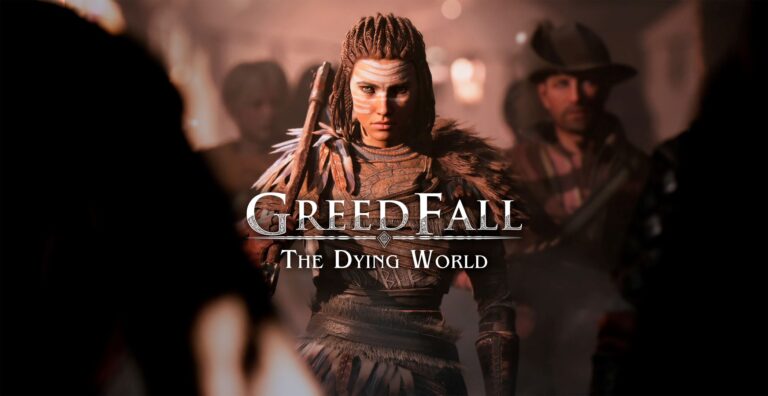
For readers interested in similar gaming experiences, Aether & Iron fits into a growing trend of narrative-focused indie RPGs that prioritize writing and unique mechanics over photorealistic graphics. Games like Greedfall: The Dying World have similarly embraced old-school RPG design philosophy with modern sensibilities.
The game also joins titles like Citizen Sleeper and Sovereign Syndicate in proving that innovative RPG combat doesn’t require real-time action—strategic positioning and meaningful choice architecture can be just as engaging.
Final Verdict: Is Aether & Iron Worth Your Money in 2026?
After 30+ hours in the floating streets of New York, I can confidently say Aether & Iron is worth your time if you’re craving something genuinely different in the RPG space.
Is it perfect? No. The technical issues are real, some systems feel underdeveloped, and the pacing occasionally stumbles. But the sheer creativity on display—the unique setting, the inventive car combat, the exceptional voice acting, and the dense political intrigue—makes this one of the most memorable indie RPGs I’ve played in years.
At $24.99, it’s priced fairly for the content offered. The developers at Seismic Squirrel have crafted something special here: a love letter to classic noir fiction, old-school BioWare RPGs, and Art Deco aesthetics that somehow coheres into a singular experience.
If you’ve been waiting for an RPG that takes risks, that trusts you to handle complex themes and tactical challenges, that doesn’t hold your hand—Aether & Iron delivers.
Final Score: 8.5/10
Pros:
- ✅ Genuinely unique decopunk setting
- ✅ Inventive turn-based car combat
- ✅ Exceptional voice acting and writing
- ✅ Meaningful choice and consequence
- ✅ Outstanding musical score
- ✅ Strong companion characters and relationships
Cons:
- ❌ Technical bugs and performance issues at launch
- ❌ Some mechanics feel underutilized
- ❌ Occasional pacing problems
- ❌ UI can be finicky with mouse controls
Frequently Asked Questions
Q: How long does Aether & Iron take to complete?
A: The main story takes approximately 25-35 hours, depending on how much side content you explore and how thoroughly you interact with companions.
Q: Is there a New Game Plus mode?
A: Not at launch, though the developers have mentioned considering it for future updates based on player feedback.
Q: Can you romance multiple characters?
A: Yes, though pursuing multiple romances simultaneously can affect companion approval and lead to confrontations.
Q: Is the game Steam Deck compatible?
A: The game is officially labeled “Playable” on Steam Deck with the 1.0 release, though UI scaling required some adjustments.
Q: Will there be DLC or expansions?
A: The developers haven’t confirmed DLC plans yet, focusing first on post-launch bug fixes and quality-of-life improvements.
Q: Does Aether & Iron have multiple endings?
A: Yes, your choices throughout the game significantly impact the ending you receive, with several major variations possible.
Have you tried Aether & Iron? What did you think of the car combat system? Share your experiences in the comments below, and don’t forget to check out our other gaming reviews and guides for more in-depth coverage of the latest releases.
Related Articles You Might Enjoy:

Abi has been writing about gaming, sports, puzzles, and UK entertainment since 2019. She covers everything from game reviews and festival previews to your daily Wordle hints — always from a British perspective.