The Devil Wears Prada 2 review: a passable legacy sequel, that’s all
Twenty years on, director David Frankel reunites Meryl Streep, Anne Hathaway, Emily Blunt, and Stanley Tucci for a glossy but uneven sequel that lands in UK cinemas on 1 May 2026 from 20th Century Studios.
Writer: Aline Brosh McKenna
Cast: Meryl Streep, Anne Hathaway, Emily Blunt, Stanley Tucci, Kenneth Branagh, Simone Ashley, Lucy Liu, Lady Gaga
Runtime: 1 hr 59 min
Rating: PG-13 (MPAA) — BBFC certificate to be confirmed
UK release: 1 May 2026 — in cinemas now at ODEON, Vue, Cineworld, Everyman, Picturehouse
Streaming: Expected Disney+ / Hulu, circa August–September 2026 (unconfirmed)
Studio: 20th Century Studios / Walt Disney Company
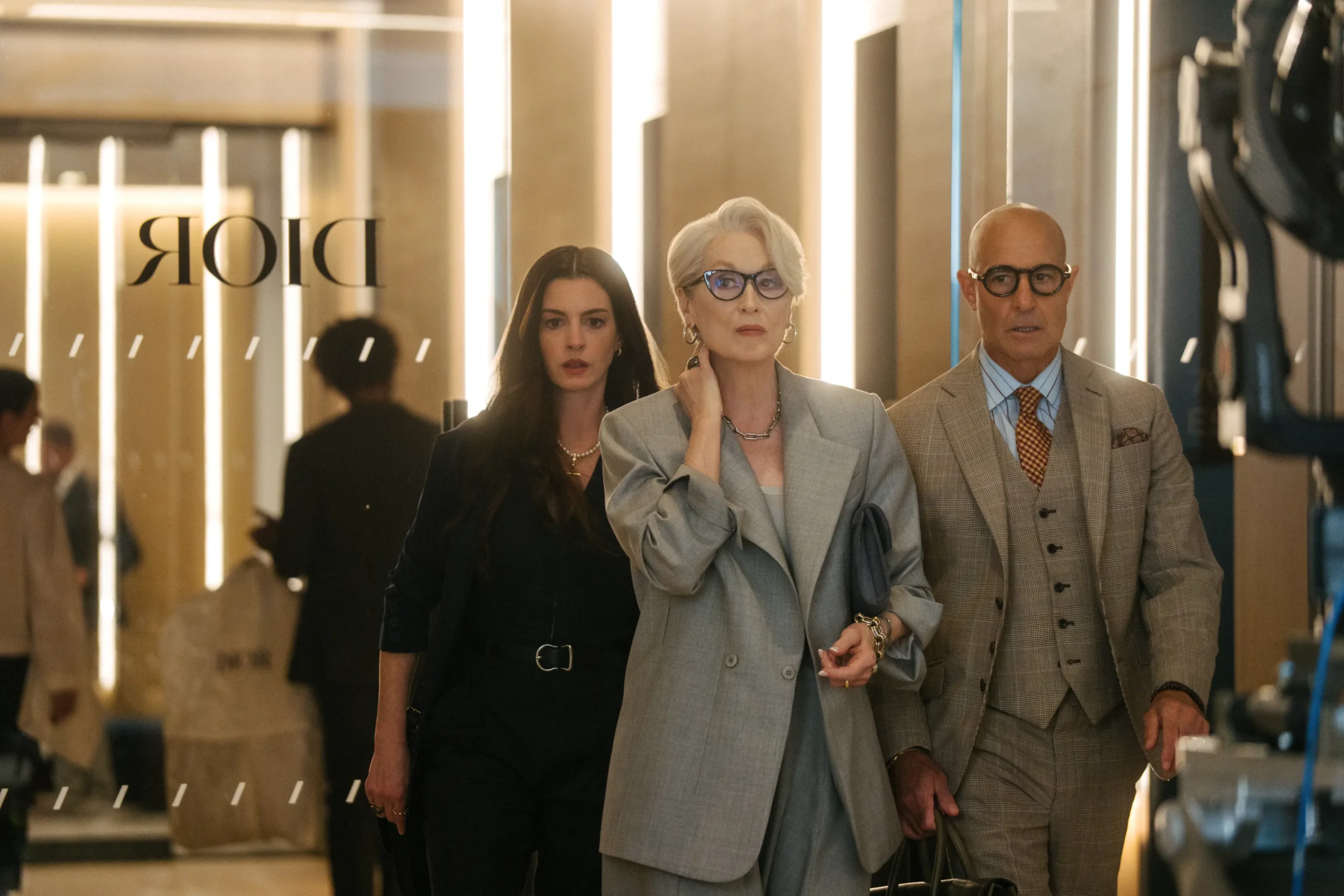
There is a moment early in The Devil Wears Prada 2 when Miranda Priestly glides into a room and every extra on screen — and, almost certainly, every person in the cinema — instinctively sits a little straighter. It is pure Streep, effortless and imperious, and it reminds you precisely why audiences waited two decades for this film. Then the plot kicks in, and some of that magic starts to fray.
What happens in The Devil Wears Prada 2?
Set roughly 20 years after the original, the story finds Andy Sachs (Hathaway) dragged back into the Runway orbit when Miranda needs her editorial flair to rescue the flagging magazine from obsolescence. Emily (Blunt) now runs a competing luxury group and holds the purse strings Miranda desperately needs. The tension between all three women is the film’s richest seam — and the one it mines least patiently.
The new additions feel, for the most part, decorative. Branagh as a media mogul circles the plot without ever quite landing. Simone Ashley and Lucy Liu are underwritten. Lady Gaga, whose original song “Runway” (co-performed with Doechii) was released as a single on 9 April 2026, appears as herself in a cameo that generates genuine electricity — and then is over in minutes.
Meryl Streep is still the whole show
Streep is, predictably, the reason to be in that seat. She finds new textures in Miranda — a tiredness behind the cruelty that reads as something approaching vulnerability. It is a more interior performance than the 2006 original, and richer for it.
“Meryl Streep still wears Miranda Priestly like a finely-tailored suit in this sinfully enjoyable sequel — dressed to the nines in off-the-rack wish fulfilment.” — Rotten Tomatoes Critics Consensus, Rotten Tomatoes
Hathaway matches her beat for beat in their shared scenes. The chemistry is intact. Blunt, meanwhile, is given the showier material — a woman who has outgrown her insecurities without losing her thorns — and she makes it count every time the script lets her breathe.
Where the script stumbles
The original film worked because it had something to say about ambition, compromise, and the cost of a career. This sequel gestures towards a commentary on digital media cannibalising traditional journalism, which is a timely idea. But as Deadline noted in its box-office coverage, audiences have shown up in enormous numbers — suggesting the nostalgia engine is more than enough to fill seats regardless of critical reservations.
The Globe & Mail’s Jehanna Schneller said the film “has zero idea what it’s about,” particularly regarding the social commentary, which reads as soft and inconsistent. That is not entirely fair — there are shrewd observations in here — but it is not entirely wrong either. Subplots accumulate and then quietly dissolve. The Milan Fashion Week sequences are gorgeous to look at and serve little dramatic purpose.
The UK angle: Emily Blunt brings it home
For British audiences, there is particular pleasure in watching Emily Blunt — Berkshire-born and a stalwart of UK screen talent — command every frame she occupies. Emily Charlton’s arc is arguably the most satisfying of the three leads, moving from the frantic assistant of 2006 to a woman with genuine power who has never quite stopped performing.
Kenneth Branagh, too, brings his customary authority to a role that needed more pages. The Devil Wears Prada 2 had its London premiere on 22 April 2026, with the full cast in attendance — and from reports, the audience responded with the kind of warmth the film works hard to earn.
Verdict: nostalgia well-served, ambition less so
Films like this carry an unfair burden: the original was a cultural landmark and this is not. Judged on its own terms, The Devil Wears Prada 2 is an agreeable, intermittently sharp, and often beautifully performed piece of commercial filmmaking. It is not a disappointment so much as a relief — proof that the cast’s chemistry survived two decades and a sequel’s worth of expectation.
What it is not is necessary. The story it needed to tell has been retrofitted from a sketch into a feature, and the joins show. Frankel keeps things moving with professional confidence, and Brosh McKenna’s dialogue crackles whenever Miranda and Andy share a room. But the film earns its “passable” with relative ease — and that, for a project of this scale, is perhaps the most damning verdict of all.
Go for Streep. Stay for Blunt. Forgive the rest.
★★★☆☆ — 3 out of 5
Also on BriefLedger: Blue Heron is the best film of 2026 so far · Ted Lasso season 4 teaser drops with premiere date · Netflix developing Nanny Diaries series with Scarlett Johansson producing
Chloe Jones is a film and television critic dedicated to providing expert analysis of movies, web series, and the latest in prestige TV. Known for her insightful perspective and deep industry knowledge, Chloe helps audiences navigate the crowded streaming landscape with honesty and expertise. Folow me on letterboxd